Getin Lab
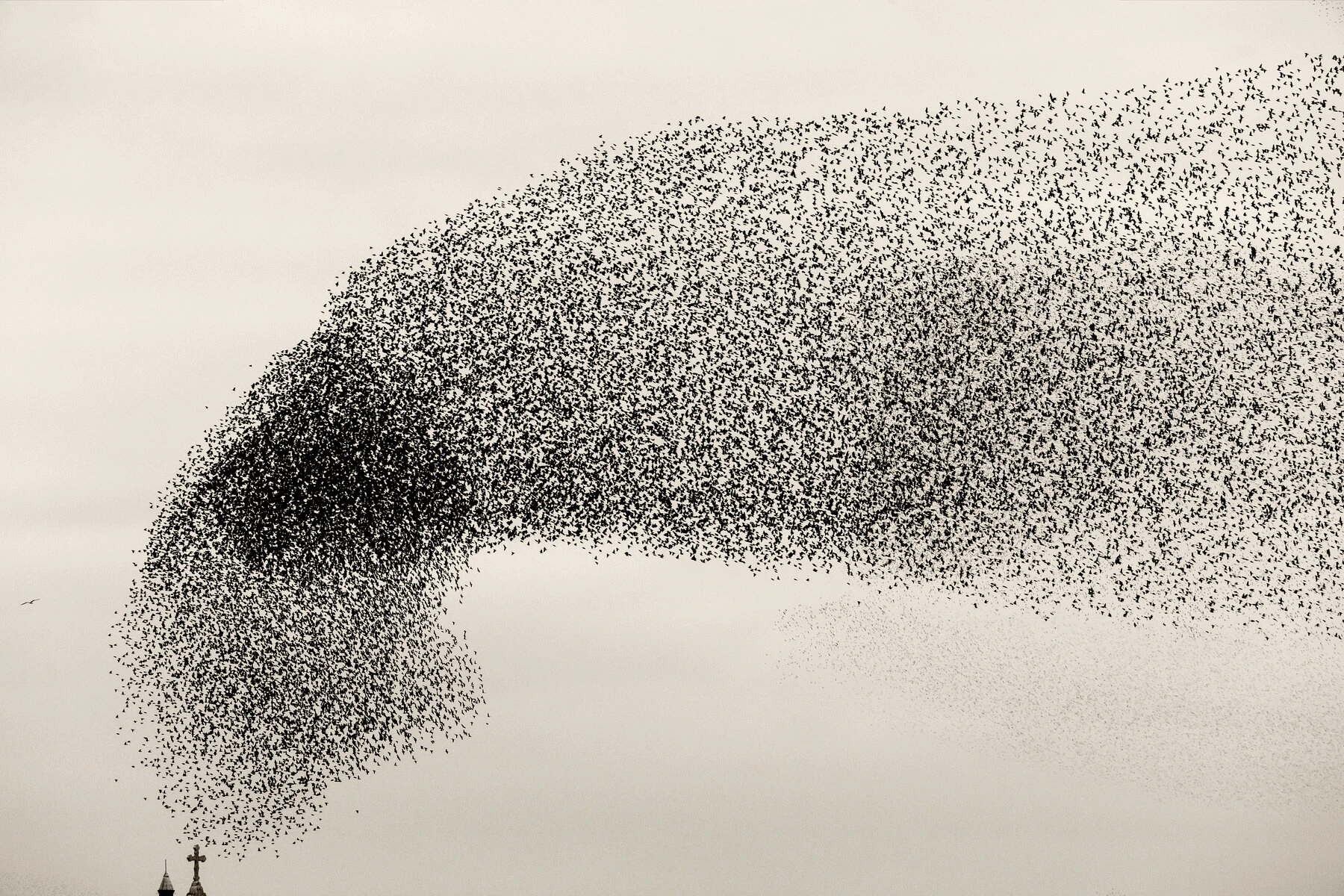
A vast murmuration of starlings arcing across the sky as one shifting body
Getin Lab — Autonomous site & airspace security Yerevan, Armenia

Getin Lab

MURMUR — the shared intelligence that makes a fleet of robots act as one.

Many eyes. One picture — even when the network drops. We turn a fleet of small robots into one team watching your site — on the ground and in the sky above it: holding formation without GPS and staying online when connectivity falters. It senses, locates and decides what matters; you stay in control.

Critical infrastructure · Energy · Ports · Airports · Data centres The MURMUR platform
The problem

A perimeter watched by blind spots.

The watch today

Large and remote sites — energy plants, ports, data centres, logistics yards — are held by fixed cameras and roving patrols. Cameras are static and blind between points; patrols can only be in one place at a time. The gaps move with them.

When the network drops

Most systems lean on a constant cloud or radio link and on GPS to know where things are. The moment connectivity is congested, interfered with, or simply out of range, they stop knowing what they're looking at — exactly when it matters most.

The idea

A flock no hawk can catch — and no one commands.

A single starling is easy prey. Ten thousand become a murmuration — one shifting body with no leader to lose. Each bird simply watches its nearest neighbours, and from those simple rules a single intelligent body emerges. MURMUR turns scattered robots into that murmuration on your perimeter: no centre to fail, no single point to lose.

What we build

We don't sell one robot. We sell the shared intelligence that makes many act as one.

MURMUR is Getin Lab's platform. It watches, locates and decides — and keeps people in control. The platform is modular and open: snap in a response system and the same brain can act, always with a human on the loop. Perception runs on open vision-language models, fine-tuned on our own data; the part that decides and prioritises is built by us. It plugs into the control systems you already run — no new screen to learn.

NVIDIA Isaac Sim Jetson edge compute Open VLA models ROS 2

We build on proven tools — and spend our effort on the part they don't give you.

SensorsADOPT Perception · VLAADOPT + FINE-TUNE Localisation — without GPSOURS CoordinationOURS — THE HARD PART Decide & prioritiseOURS Action — snaps onOPEN

Fig. — One brain, many bodies. The middle is ours; the top is open.

Why density wins

Many, not few — the robots are the line.

A FEW NODES gaps = blind spots ▢ gap ▢ gap A DENSE TEAM no gaps · no blind spots

Fig. 1 — Coverage. Dense nodes leave no seams.

  • 01No gaps. The robots are the line — nothing slips between them.
  • 02No single point of failure. Lose a few and it keeps working; a couple of expensive machines fail as a unit.
  • 03Many eyes. Seeing the same thing from several angles makes positioning far more accurate — fewer false alarms.
  • 04Catch the faint stuff. What one robot misses, many together confirm.
One mixed fleet

The right machine for every part of the site — composed as one team.

Dogs, rovers & more

Quadruped robots take stairs and rough ground; wheeled rovers bring endurance and payload; partner-built radar nodes watch the sky; modular interceptor nodes respond. MURMUR composes the best mix for each site and shift.

Always covered

Every point is watched by two or more robots, so detection is confirmed from several angles — far fewer false alarms, far fewer misses.

Never off-duty

Roughly a third stay on watch while the rest charge, then surge to full strength on demand. Detach a group for a second area while the main line holds.

Counter-UAS · Airspace security

Your fences are watched. Your sky is not.

In 2025, drone incursions shut down more than 24 airports across 12 countries — and reached energy plants, ports and data centres. Most counter-drone (C-UAS) systems are fixed masts with a single vantage point. MURMUR protects the same site from the ground up: the fleet that watches your perimeter also watches the sky above it.

Radar findsPARTNER NODE Vision confirmsMANY EYES · PASSIVE One fused 3D trackOURS Interceptor respondsHUMAN ON THE LOOP EMITTERS OFF? THE PASSIVE MESH STILL SEES.

Fig. — The chain. Radar finds · vision confirms · a fused track · an interceptor responds.

  • 01Radar finds. Partner-built radar nodes join the fleet and spot a drone kilometres out.
  • 02Vision confirms. A drone seen from many angles becomes one precise 3D track — passively, even when GPS and networks drop.
  • 03Interception snaps on. Modular interceptor nodes respond — always with a human on the loop, deployed only where the operator holds the authority.
  • 04Detection works everywhere. The air picture ships to any site; response modules are added where regulation allows.
The hard part

Knowing where you are — without GPS.

GPS / satellitesassume unreliable Map-matchingneeds landmarks Watch each otheralways on FUSE knows its shape anchors → map

Fig. 2 — Three channels, one shape.

  • 01Three ways to know where it is, blended — satellite positioning (assume unreliable), terrain map-matching, and robots watching each other.
  • 02Watching each other always works — even with GPS gone and no landmarks, robots that can see their neighbours fix their own geometry.
  • 03A few anchors tie the whole shape to the real map.
  • 04This is our core invention — built by our in-house engineering bench in Yerevan.
Stays online as the network fails

Same picture, less certainty — never blind.

Like a good team: take direction from the control room, then hold the picture between yourselves, then go eyes-on and keep to the plan. As each link drops, MURMUR keeps producing an answer — it just carries honest uncertainty with it.

Intelligence you can trust

Our AI doesn't just flag something — it shows its work.

What it saw, how sure it is, and why it ranked one thing ahead of another. We use vision-language models and wrap them so a person can follow the reasoning and stay in control — transparent and explainable, not a black box.

Where it fits

Built for sites where a gap is not an option.

01 — Energy & utilities

Power generation, substations, pipelines and remote installations spread across ground that patrols can't continuously cover.

02 — Ports, airports & logistics

Terminals, yards and aprons where the fence line is long, busy, and changing by the hour — and where the airspace above now needs the same watch.

03 — Data centres & campuses

High-value private sites that need continuous, confirmed coverage and stay running when connectivity is degraded.

We start where the cycle is fast and the value is clear — commercial critical-infrastructure perimeters — and grow through partners into larger programmes across energy, ports, airports and infrastructure worldwide.

Beyond security

When infrastructure fails, the mesh keeps talking.

The same properties that hold a perimeter — a fleet that carries its own network and knows where it is without GPS — are exactly what disaster response needs when communications and power are down. Earthquake search across ground no wheeled vehicle can enter; wildfire perimeter watch through smoke; relay nodes that carry connectivity to cut-off teams. A second field we will enter with partners.

Where we are — two years in
2 yrs
building fully integrated mechanical, electrical and software prototypes
11
R&D engineers — robotics and AI under one roof in Yerevan
100 ms
see-to-react loop in our tracking engine, on edge hardware
500 m+
precision tracking range, running at the edge
01 — Tracking engine

A closed-loop visual tracking engine, built and deployed: locks on and verifies a target to sub-centimetre precision at range, on compact edge hardware.

02 — First-party nodes

Robotic node types designed and built in-house — an autonomous precision interceptor is built, and an anti-drone node ships this year. Proof the same brain composes real, heterogeneous hardware into one coordinated team.

03 — Live toolchain

A zero-copy edge pipeline (>30 FPS), Isaac Sim digital-twin validation, and a hardware-agnostic ROS 2 API that plugs into third-party cameras, robots and control systems.

Team

Robotics and AI under one roof.

CEO

Gor Vardanyan

Founder & CEO — his fourth company. Previously built visual navigation for UAVs operating in GPS-denied conditions — the problem at the heart of MURMUR — and has hired and managed hundreds of deep-tech engineers.

Co-founder & CTO

Armen Khachikyan

Co-founder & CTO, with roughly two decades of domain-specific engineering experience — including eight years building and leading IntelinAir's 40-engineer Armenian subsidiary.

An in-house AI research team means robotics and models move together — no hand-offs between teams, no hiring lag on the scarcest skill. We are anchored in Armenia's deep AI-research community in Yerevan, with world-class applied-ML talent close at hand. The in-house bench owns integration, productisation and deployment.

No centre to fail. No blind spots. One picture that holds. — Getin Lab · the MURMUR platform